
Yes, at the time void gush Raimi Spider-Man 4 at the beginning of 2010 yesterday, most people immediately predict that World of Warcraft movie will be the next port for Raimi. But it turns out it is totally wrong, because apparently more interested Raimi to refine the mainstay of one of the old Disney movies, Wizard of Oz.
Last time there was news about the Warcraft movie, Raimi has said that there is a script that still needs much reform. "We are now trying to create a story," explained director in June 2010 yesterday. "We've got 40 pages of a thick document that still needs much improvement, but the script that we are doing together with Robert Rodat is the longer the better."


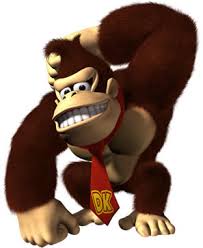
Donkey Kong (ドンキーコング, Donkī Kongu?) is a fictional ape who first appeared in Nintendo's popular 1981 video game of the same name.
Creation
Donkey Kong was created by game designer Shigeru Miyamoto, along with two other characters, as an original property of Nintendo once their licensing of Popeye fell through. The three characters were supposed to mirror the love triangle that exists in the Popeye comics. Donkey Kong was cast as the antagonist, with the creator explaining that a gorilla is not "too evil or repulsive". Shigeru believed "donkey" meant "stupid" in English, and assumed the name Donkey Kong would convey the sense "stupid ape" to an American audience.When he suggested this name to Nintendo of America, he was laughed at, but the name stuck.
Early history
Donkey Kong made his first appearance as the titular character of the 1981 arcade game Donkey Kong alongside protagonist Mario (then known as "Jumpman") and damsel in distress, the Lady (later renamed Pauline). As Jumpman, the player must reach Donkey Kong at the top of each stage, where he is holding the Lady captive. Donkey Kong attempts to hinder the player's progress by throwing barrels, springs, and other objects towards Jumpman. The ape reappeared the following year in the sequel Donkey Kong Junior, where Donkey Kong is taken captive and locked in a cage by the re-named Mario, while Donkey Kong Junior sets out to rescue him. Donkey Kong resumed his antagonistic role in Donkey Kong 3, this time the character Stanley The Bugman taking Mario's place as the protagonist. Stanley fights Donkey Kong's attempts to invade a greenhouse along with a horde of killer bees.
After Donkey Kong, Mario went on to become Nintendo's primary mascot, while Donkey Kong and his son were relegated to supporting roles and cameos such as in the arcade version of Punch-Out!!, Super Mario Kart, and the Virtual Boy game Mario's Tennis. The 1994 Game Boy version of Donkey Kong marked his re-emergence as a major character. He was redesigned, appearing with a red necktie, which sometimes bears his initials, "DK".
Rare era
The 1994 Super Nintendo Entertainment System game Donkey Kong Country, developed by British game developer Rare, marked a turning point for Donkey Kong by creating a new setting, Donkey Kong Island, and backstory for the character. While retaining the red necktie, he also donned a distinct physical appearance featuring heavy brows and a peaked lock of hair on top of his head. This would become the standard look for Donkey Kong still used over a decade later.
The character is reintroduced in Donkey Kong Country as the grandson of the original Donkey Kong[4], who appears in the game as an elderly ape named Cranky Kong.[5] A representative of Rare stated shortly after the release of Donkey Kong 64, however, that the current Donkey Kong was meant to be an adult version of Donkey Kong Junior[6] (indeed, Cranky's reference to Donkey as his "son" in the game (and associated materials) seems to indicate this to be the case[7][8]). In the Rare revamp, Donkey Kong is portrayed as a powerful yet lazy and laid-back ape, who is interested mainly in his banana hoard. The series introduced Diddy Kong as Donkey's sidekick, and King K. Rool as his nemesis who steals the banana hoard.
Despite his name being in the titles of both games, DK is not the protagonist in the sequel Donkey Kong Country 2: Diddy's Kong Quest nor Donkey Kong Country 3: Dixie Kong's Double Trouble!. Instead he is captured by K. Rool, while the player controls different Kongs who have set out to rescue him. The Donkey Kong Country series also inspired the Donkey Kong Land trilogy and a television series.
DK also appears in Donkey Kong 64 for the Nintendo 64 and the Mario Kart series from Mario Kart 64. With this, he became a regular playable character in the Mario sports series and other spin-offs such as Mario Party and Super Smash Bros..
Post-Rare era
Following Rare's departure from the series, Nintendo co-produced a trilogy of rhythm games with Namco for the Nintendo GameCube known as the Donkey Konga series, which were based on Namco's own Taiko: Drum Master, though only two of the series' games made it to America. Donkey Kong Jungle Beat was released on March 14, 2005 in North America for the GameCube. It depicted DK as being more violent than his original image and also used the bongo controllers. In October 2007, Donkey Kong: Barrel Blast was released in North America for the Wii.
On handheld consoles, Donkey Kong was reunited with his former rival Mario in the 2004 Game Boy Advance game, Mario vs. Donkey Kong. A throwback to the Donkey Kong game for the Game Boy, Donkey Kong resumed his antagonist role from his earlier games by taking over the Mario Toy Company, upset over the lack of Mini-Mario toys available for purchase. The game was followed by a 2006 sequel titled Mario vs. Donkey Kong 2: March of the Minis, where Donkey Kong, who is infatuated with Pauline, kidnaps her and takes her to the roof of the Super Mini-Mario World amusement park when she ignores a Mini Donkey Kong toy in favor of a Mini-Mario. Aside from those, Donkey Kong appeared in DK King of Swing on the GBA around the time of Jungle Beat, and in its sequel, DK Jungle Climber, for the Nintendo DS, which was released in North America on September 10, 2007. Jungle Climber took the gameplay of its predecessor, KoS, and mixed it with the style, locations, and items of the Donkey Kong Country trilogy.
Baby Donkey Kong
Baby DK is a baby version of Donkey Kong. He first appeared in Yoshi's Island DS and then in Mario Super Sluggers. He is not to be confused with Donkey Kong Junior, who is the young version of the second generation in the Donkey Kong family. Even as an infant, he possessed quite powerful strength; being able to support both Yoshi and himself by swinging on vines in order to navigate the area.
Here are 10 things you may not know about our favorite video game character Mario:
- Mario was first seen in the video game Donkey Kong, but he was called "Jumpman." He was also a carpenter then, not a plumber.
- Mario was named after Mario Segale, the landlord of Nintendo of America’s office, who barged in on a company meeting demanding an overdue rent.
- Shigeru Miyamoto drew Mario as wearing a cap because he found drawing hair difficult. He also drew in the moustache, because it was easier to see than a mouth in the crude video game screen resolution back then.
- Mario and his younger brother Luigi are known as the "Mario Brothers." This means that Mario’s last name is also Mario, so his full name is Mario Mario.
- Mario is voice-acted by Charles Martinet, who crashed the audition for "an Italian plumber from Brooklyn" character.
- Mario’s nemesis is Wario (a combination of “warui”, the Japanese word for bad, and Mario). Similarly, Luigi’s rival is Waluigi. Both are also voiced by Charles Martinet.
- Mario has appeared in over 200 video games so far, has sold over 193 million units of games (all of the Mario series) and even has his own TV cartoon show. Super Mario Bros. 3 alone grossed over $500 million in USA.
- TV Schmeve, you’re nothing till there’s an opera done on you. In 2003, Jonathan Mann of California Institute of Arts created The Mario Opera
- uper Mario Bros. theme music, written by Koji Kondo, is known worldwide. It has inspired countless fan-renditions, including one played by Zack Kim on two guitars (viewed over 4 million times on YouTube!), played by Jean Baudin on 11 string bass, beatboxed by Greg Patillo on the flute, and played by the Oregon Pro Arte Chamber Orchestra on the trombones.
- Mario is the most famous character in the history of video games, and perhaps is the most famous character ever. In a 1990 poll by Marketing Evaluations, Mario was found to be more popular (and recognizable) among children than Mickey Mouse.
Read More......

In this game, Mario is portrayed as an Italian-American plumber who, along with his brother Luigi, has to defeat creatures that have been coming from the sewers below New York.[2] The gameplay focuses on Mario having to exterminate pests in the sewers by flipping them on their backs and kicking them away. The original versions of Mario Bros., the arcade version and the Nintendo Entertainment System version, received positive reception. In Japan, the Nintendo Entertainment System version of Mario Bros. had sold more than 1.63 million copies.
Gameplay
Mario Bros. features a scoring system in which points can be earned in several ways, such as by collecting coins or defeating enemies. The player gains points by defeating multiple enemies consecutively and can participate in a bonus round to gain more.Enemies are defeated by running up to them and kicking them when they are flipped on their back. Player cause enemies to flip by hitting them from below the platform they are on or by hitting the POW block to overturn all enemies on the ground. If the player allows the enemy to get up, the enemy becomes angry and increases in speed. Each phase has a certain number of enemies, ended with a more powerful enemy. Enemies come in variants—for example, Sidesteppers, a type of crab, are usually red, but turn blue and become faster when they recover from being flipped or if they are the final enemy. Each enemy has their own mechanics—the Shellcreeper, a type of turtle closely related to Koopa Troopas, can be made vulnerable by hitting them from below once, the Fighter Fly, a type of fly, jumps into the air every once in a while and must be hit from below when they are not in the air, and the Sidesteppers must be hit twice from below in that fashion to become vulnerable. Another enemy is called a Freezie, which has the ability to melt down and freeze the platform it is on, making it more difficult for the player to control the characters.
Development
Because of Mario's appearance in Donkey Kong, with overalls, a hat, and a thick moustache, Shigeru Miyamoto thought that he should be a plumber as opposed to a carpenter, and designed this game to reflect that. Another contributing factor was the game's setting: it was a large network of giant pipes, so they felt a change in occupation was necessary for him. A popular story of how Mario went from Jumpman to Mario is that Nintendo's Italian landlord, Mario Segale, had barged in on them to demand rent, and they decided to name Jumpman after him. Miyamoto also felt that the best setting for this game was New York because of its "labyrinthine subterranean network of sewage pipes." Mario Bros. is one of the first platform games ever created, along with Donkey Kong. It also introduced Mario's brother, Luigi, who was created for the multiplayer mode by doing a palette swap of Mario. The two-player mode and several aspects of gameplay were inspired by an earlier video game called Joust. To date, Mario Bros. has been released for more than a dozen platforms. The first movement from Mozart's Eine kleine Nachtmusik is used to open each phase. This song has been used in later video games, including Dance Dance Revolution Mario Mix and Super Smash Bros. Brawl.
Ports and follow-ups
Mario Bros. has been re-released many times by itself and as a sub-game in other games. It was also rereleased on the Wii's Virtual Console service in North America, Australia, Europe and Japan. It is also remade on copies of games in the Game Boy Advance's Super Mario Advance games as well as Mario & Luigi: Superstar Saga, and it was included as a mini-game in Super Mario Bros. 3. The NES version was included as a piece of furniture in Animal Crossing for the Nintendo GameCube, along with many other NES games, though this one required the use of an e-Reader, a Game Boy Advance accessory, and an Animal Crossing e-Card.This version was released in the second series of NES e-Cards as well, and was also released in the Famicom Mini series, the Japanese variant of the Classic NES Series of games. It never came outside of Japan.[33] A remake was made called Mario Bros. Classic—known as Kaettekita Mario Bros. (かえってきたマリオブラザーズ, Return of Mario Bros. or Mario Bros. Returns?) in Japan—featuring similar gameplay with added features and new revisions to the gameplay. It also featured cut-scenes and advertisements.
Hudson Soft made two games based on Mario Bros.. The first was Mario Bros. Special, which was a re-imagining of the original Mario Bros. with new phases, mechanics and gameplay. The second was Punch Ball Mario Bros., which featured a new gameplay mechanic involving punching small balls to stun enemies. Both games have been described as average for the most part, neither the best or worst games in the series.
A sequel to Mario Bros., Mario Clash, was released in 1995. The game was released for the Virtual Boy and produced by Nintendo. It is the first 3D Mario game and is heavily based on Mario Bros.. The objective of the game is to knock all the enemies in a particular phase off ledges. Instead of hitting them from below, like in Mario Bros., the player must hit enemies using Koopa shells.

This game propelled the Genesis into mass popularity in North America. After it was released, it eventually replaced Altered Beast as the game bundled with the console, and was later replaced with its first sequel, Sonic the Hedgehog 2. The game featured many novel elements which contributed to its popularity and helped to promote the uptake of 16-bit consoles. The game is widely considered to be one of the greatest games of all time, placing #63 on IGN's 2007 list.
Sonic the Hedgehog added the element of speed to the standard platform formula and introduced other unique elements as well, such as the loops, springboards, high-speed devices, and the rings now permanently associated with the game series.
The game was both a critical and commercial success. As of November 19, 2007, the game has sold 4 million copies, the second-highest amount for a Genesis game, behind Sonic 2, which has sold 6 million copies.
Overview
In the game, Sonic has to prevent Dr. Robotnik from collecting six (seven in the later games) of the Chaos Emeralds in an attempt to rule South Island. He must traverse six "zones", each comprising three stages or "acts", until he confronts Robotnik for the last time in the Final Zone.
The gameplay centers around elements that exploit the increased performance of the 16-bit console over its 8-bit forebears. It is notable for being both simplistic and engaging for players.
Sonic could run, jump, and roll at significantly higher speeds than most platformers of the time. Unlike other platformers, the game's levels were designed to encourage the player to progress quickly. Springs, slopes, high falls and loop-de-loops were all available to both boost and challenge the player to reach high speeds. This was all accomplished without any slowdown in framerates, adding to the experience.
Features
Essential to the gameplay are the golden rings the player collects along his/her way in each level; a feature which would become one of the defining characteristics of the series. These items are regularly placed around the level map and serve multiple functions. First, the player collects rings to protect Sonic. As long as they have at least one ring, the player will not lose a life when injured. Instead, when hit, up to 40 of the rings the player has collected will fly outward and scatter around the immediate area, some of which can then be retrieved before they disappear. If the player runs into an enemy without a single ring, they will lose a life. If the player collects 100 rings they will gain a life, and gain an additional life for every 100 rings after that, provided the rings are not lost.
If the player has at least 50 rings at the end of an act, a giant golden ring will float above the finishing sign which can be jumped through to enter one of the Special Stages (this excludes the final act of a stage, when Sonic will enter a boss fight). At the end of each act, the total number of rings the player has is multiplied by 100 and added to the player's score. During the score-tallying, the player can also jump through the air to find hidden emblems which can range from 100 to 10,000 points.
Also scattered throughout each level are monitors which, when broken by the character, reward the player with one of a variety of bonuses. These include a shield which will protect Sonic from a single hit, a 10-ring bonus, an extra life, temporary invincibility (accompanied with a temporary change in music), and "Super Sneakers", which give the player a temporary speed boost (and increase the tempo of the music for the duration). The item monitors have become another long-lasting feature in the series, though they have been changed to bubble-like containers in later games.
Despite the various types of protection available, neither the shield, rings, nor invincibility will prevent the player losing a life if Sonic is crushed (by a trap or between a wall and a moving platform), drowned, runs out of time (each act has a ten-minute time limit), or falls into a bottomless pit.
Progression through the game is made easier for the player by lamp posts that act as checkpoints. When Sonic passes a lamp post, its color changes from blue to red, and the next time a life is lost, gameplay will restart at that point rather than at the beginning of the act. In the Japanese version, if a checkpoint is activated and a life is lost as a result of running out of time, the time at the checkpoint will reset to 0:00.
Hazards the player experiences include a wide variety of "badniks" - these appear as animals trapped inside mechanical bodies which are released the moment the player hits them. Each badnik takes one hit to destroy, but they vary greatly from Zone to Zone; some will walk in a set path, others will try blasting the player, and some cannot be avoided at all. The player must also avoid rows of sharp spikes, cliffs, and elaborate death traps. There is also the threat of drowning, as the player can only survive approximately 30 seconds underwater (locating air bubbles can extend this).
The game features no game saves or passwords. This means that the game has to be restarted from the beginning when the player runs out of continues or turns off the system unless the player uses a cheat code to access the level select screen.
Graphics and sound
At the time of its release, Sonic the Hedgehog boasted impressive 16-bit graphics, with richly animated sprites and varied colors, fully utilising the Mega Drive's enhanced color palette. Flowers moved, rings spun, lights blinked, and water shimmered in the background.
The game also takes full advantage of the on-board Zilog Z80 and Yamaha synthesizer sound chip, and is filled with sound effects, chimes, bops and beats following the player through the levels. Many sounds play on top of one another and most of the game's sounds were unique and of higher quality than earlier 8-bit sounds.
Besides detailed sound and animation, Sonic the Hedgehog is especially known for its dynamic music, composed by Masato Nakamura, a member of the popular J-Pop band, Dreams Come True. Using 8-bit stereo sound, the music is rich and varied throughout each level. Particularly notable are the game's recognizable main theme and the music to Star Light Zone. Sonic the Hedgehog's soundtrack is still highly popular in remixing communities on the Internet, such as OverClocked ReMix. Similarities to the Green Hill Zone theme can be found in "Dreams of an Absolution", the theme for Silver the Hedgehog in the 2006 Sonic game, also called Sonic the Hedgehog, though the song's composer Lee Brotherton claims that this was an unintentional coincidence.
Character art and game packaging
Akira Watanabe, the illustrator of the character art, said that his sole goal was to depict the characters as "colorful" and to use clear cutting lines and gradation to "finish them neatly."
Watanabe said that the developers asked him to create a package design "similar to pop art." Watanabe aimed to create the design "without being particular to conventional packages." Watanabe intended to create an "original, stylish pop game package."
Development
Development for Sonic the Hedgehog began in April 1990, after Sega ordered its AM-8 team to develop a game featuring a mascot for the company. After choosing a hedgehog as the main character, the 5-person group changed its name to Sonic Team and started working on Sonic the Hedgehog. The main minds behind the game were character designer Naoto Ohshima, game programmer Yuji Naka and designer Hirokazu Yasuhara.
The game was originally intended to feature a sound test menu, with animated graphics based around Sonic break-dancing to the music of a "Sonic Band"consisting of Sharps Chicken (guitar), Max Monkey, (guitar), Mach Rabbit (drums), and Vector the Crocodile (keyboard/synth);[citation needed] Vector was later re-designed and re-used for the games Knuckles' Chaotix and Sonic Heroes.[citation needed] The development schedule meant that the feature had to be scrapped, and Yuji Naka decided to replace the test with the "SEGA!" chant used in TV advertisements, which took up 1/8 of the 4-megabit cartridge. A text-only sound test option remained in the final game's level select cheat menu.
This is the only Mega Drive/Genesis Sonic game made entirely in Japan/Korea. Although Sonic the Hedgehog CD was made in Japan as well, Sonic the Hedgehog 2, Sonic the Hedgehog 3, and Sonic & Knuckles were produced in North America at Sega Technical Institute, albeit with almost exclusively Japanese staff members. Sonic the Hedgehog Spinball, however, was produced almost entirely by Americans, the only Sonic game to date to do so. Sonic 3D featured Japanese staff, but much of the work was done by the UK-based video game company Traveller's Tales, who also produced Sonic R.
Versions and releases
The first version, released in North America and Europe, lacked some graphical enhancements that were added to the later Japanese release. The Japanese version included clouds that moved independently of the scrolling background (even when the main character stands still) in the Green Hill Zone and two water graphical effects in the Labyrinth Zone, which consisted of a rippling effect on the foreground and a swirling effect on the background. This effect was only applied to the areas that were under the water line. Also in the Japanese version, all levels of the game had many more layers of parallax scrolling in their backgrounds.
The first version also gave the player an enormous 250,000 point bonus if a stage was cleared in less than 30 seconds. Subsequent revisions cut the bonus down to 50,000.[citation needed]
The later Japanese version 2.0 fixed the "spike bug" (a bug in which Sonic would instantly die if he "bounced" from one set of spikes to another due to him not gaining temporary invincibility until his feet touched the ground). Also fixed in both Japanese versions is the level select cheat, which listed the game's levels in an erroneous order.
In addition to this, due to differences between standard PAL and NTSC refresh rates, the European version of the game played at about 83% speed of the NTSC version[5] (which also slows down the music to the point of notice), a problem that has been fixed for the remaining Mega Drive Sonic games, but not for Sonic the Hedgehog's appearances in some of the collections (e.g. Sonic Jam) or the Wii's Virtual Console version of the game.
8-bit version
A new version of the game, which was entitled Sonic the Hedgehog Genesis, was released for the Game Boy Advance in November 2006 as part of the celebrations of the original game's 15th anniversary. The game is a remake of the original game as opposed to a port. It includes a new save feature and a special "Anniversary Mode" featuring the Spin-Dash move that was added in later games. In addition, the view is slightly zoomed in and adapted for the GBA's widescreen aspect ratio, and the level select and debug codes have been left out, the former due to the fact that there is already a zone select screen.[7] The reception was negative, as many reviewers criticized the game for its slow frame rate, music, and glitches -- most called the game "unplayable."
Compilations
That include the game are Sonic Compilation (1995) and Sega 6-Pak (1996) for the Sega Genesis; Sonic Jam (1997) for the Sega Saturn; Sega Smash Pack (1999) for the Sega Dreamcast; Sonic Mega Collection (2002) for the GameCube; Sonic Mega Collection Plus (2004) for the PlayStation 2, Xbox and PC, SEGA Mega Drive Collection PSP and Sega Genesis Collection (2006) for the PlayStation 2 and PlayStation Portable, and Sonic's Ultimate Genesis Collection for the Xbox 360 and PlayStation 3.
The Sonic Jam version, like all of the four games included in the title, was given "easy" and "medium" options (as well as an "original" option, the game as it was) that removed acts, bosses, enemies, spikes, traps and pits. These "easy" and "medium" options were not included with any other versions of the game. In addition, the Spin-Dash, a move that did not debut until Sonic 2 the following year, was implemented in the first game. It is interesting to note that the spike bug from earlier versions of Sonic the Hedgehog can be triggered if Spin Dash is turned off.
Sonic Mega Collection and Mega Collection Plus feature all three revisions of the game. The GameCube PAL edition of Mega Collection for the GameCube supports a 60 Hz option, which not only allows the game to be played full-screen and at its original speed, but also allows either the US or Japanese version 2.0 iterations to be played via a cheat code (the first Japanese version is the default). If the 50 Hz option is selected, these cheat codes do not work and only the PAL edition of the game can be played.
In Sega Genesis Collection, both the US and European releases of this collection contain the US version of Sonic the Hedgehog.
Knuckles in Sonic the Hedgehog
In the development of Sonic & Knuckles, Sega decided to leave Knuckles the Echidna out of the original game. According to several programmers and hackers, the reason why Knuckles could not be placed into Sonic the Hedgehog like he was in Sonic the Hedgehog 2 was that the palette colors of Knuckles' sprite would have, in fact, completely altered the palette scheme of the entire game. Therefore, instead of a Knuckles in Sonic 1 feature, using Sonic & Knuckles with Sonic the Hedgehog unlocks the full version of the Blue Sphere game.


